Descriptions
EXHAUST EMISSION CONTROL SYSTEM
Engines: 2.0 16V
CONSTRUCTION SPECIFICATIONS
These devices are fitted with two aims:to reduce pollutants present in exhaust emission by means of the catalytic converter;to prevent uncombusted hydrocarbons from escaping into the air by means of the evaporation control system (fuel) and oil vapour recirculation system (lubricant).CATALYTIC SILENCER
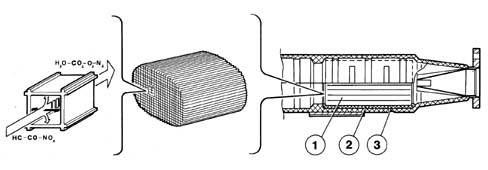
The catalytic converter is a device that can remove the three main polluting compounds present in exhaust gases simultaneously: unburnt hydrocarbons (HC), carbon monoxide (CO) and nitrogen oxides (NOx).Two types of chemical reaction take place inside the converter:oxidation of CO and HC to carbon dioxide (CO2) and water (H2O);reduction of NQx to nitrogen (N2).This reactions can take place very quickly due to the presence of a layer of active substances (platinum and rhodium) inside the converter structure (ceramic mount) that accelerate the conversion rate of harmful substances enormously. The efficiency of this conversion process is affected by the fact that the concentration of the mixture on which the engine runs fluctuates continuously about a stoichiometric level. This is achieved by the feedback control exercised by the control unit on the basis of signals from the lambda sensor. The conversion processes are also active at temperatures in excess of 300 - 350° C: it is therefore essential for the catalytic converter to reach this temperature as quickly as possible so that it can work correctly.