Descriptions
24 TRANSMISSION
Engines: 2.0 16V, 2.8 JTD 8V
Equipment / version codes: 4X4 [4x4]
Equipment / version codes: 4X4 [4x4]
INTRODUCTION
- The DUCATO 4X4 is a vehicle where the four wheel drive can be switched on so that it can tackle road surfaces in poor grip conditions.- Derived from production models and maintaining the same gear ratios, this version is marketed with an MLGU gearbox.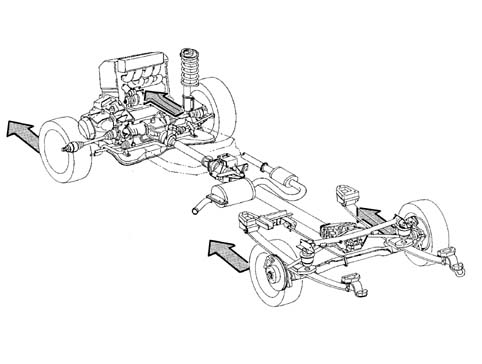
Use of the vehicle
- It is advisable to switch on the four wheel drive for journies where grip conditions are poor.- If the vehicle is equipped with a gear reduction unit, it is advisable to switch it on immediately after activating the four wheel drive. Switch off the gear reduction unit before deactivating the four wheel drive. Only use reduced gears with the four wheel drive switched on, otherwise there is a risk of damaging the front drive.- Lock the rear differential before driving in muddy conditions.- Remove any mud that may have become deposited on the wheels and on the transmission components. - When cleaning the vehicle avoid directing high pressure water jets directly onto the universal joints or the rubber covers.Switching on the four wheel drive
- To switch the four wheel drive on or off, press the green button in the dashboard.- Switch the four wheel drive on/off with the vehicle moving whilst keeping the accelerator released and the front wheels straight.
Locking the rear differential (where fitted)
- In order to lock/release the rear differential, press the special brown button in the dashboard.Use of reduced gears (where fitted)
- The vehicle may be equipped with a gear reduction unit which allows two different speed ranges:Engines: 2.0 16V, 2.8 JTD 8V
*- normal gears,*- reduced gears,
Engines: 2.0 16V, 2.8 JTD 8V
Equipment / version codes: 4X4 [4x4]
Equipment / version codes: 4X4 [4x4]
- The lever for engaging the reduced gears is located on the right side of the driver's seat. Changing from one range to the other is synchronized and requires the use of the clutch. The luminous blue warning light in the panel coming on indicates that the reduced gears are engaged.- The gear reduction unit has the following advantages:
Engines: 2.0 16V, 2.8 JTD 8V
*- slow progression on routes that are particularly uneven,*- easy take off on steep inclines or subsiding road surfaces,*- good engine braking.
Engines: 2.0 16V, 2.8 JTD 8V
Equipment / version codes: 4X4 [4x4]
Equipment / version codes: 4X4 [4x4]
Drive torque and grip
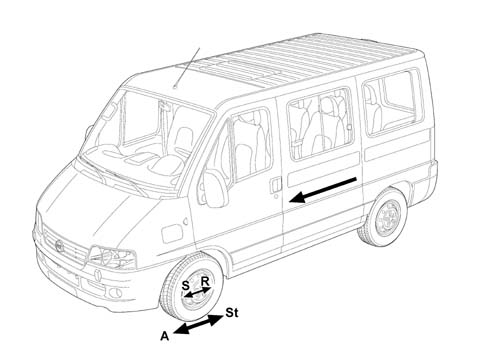
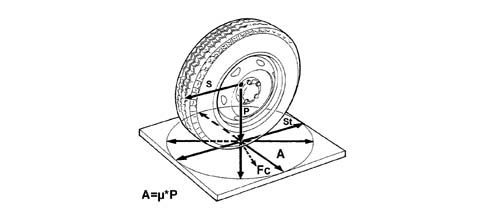
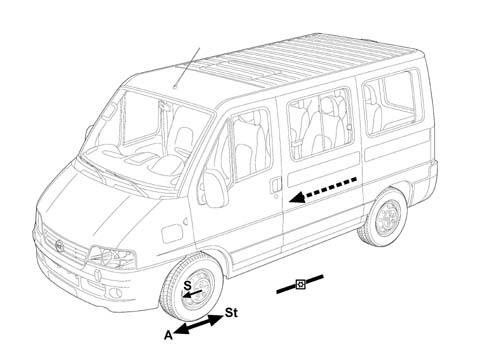
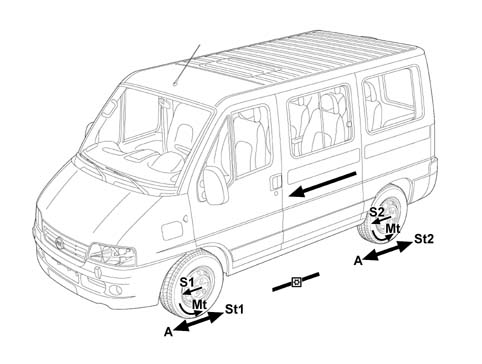
A pair of forces act on a vehicle's drive wheels (figure A), which lead to S (drive or propulsion force) and St (tangential drive force), in the same measure, whose value is determined by the ratio between the drive force Mt applied to the drive wheels and the radius r of the actual wheels: - S=St=Mt/n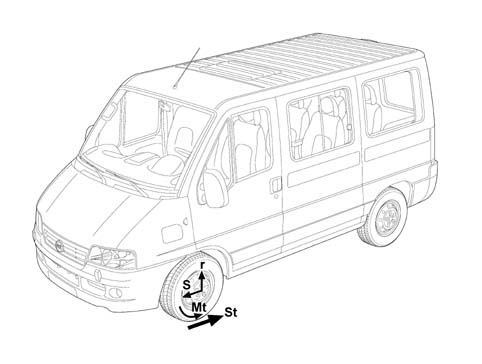
Four wheel drive
- In addition to advantages in terms of drive (full use of the available torque) four wheel drive offers further fundamental advantages in terms of safety, stability and even handling of the vehicle. - Safety: this is improved because any lack of grip of one of the drive wheels due to uneveness of the road surface (aquaplaning, icy patches, oil slicks) is compensated for by the other three drive wheels.- Stability: this is increased because there is a greater directional reserve due to a decreased drive commitment. On a vehicle with two drive wheels taking a bend (figure F) for reasons of simplicity force S is considered rather than St of the same intensity. Drive force S totally commits the available adherence range represented by the circle; the centrifugal force Fc produces a resulting T which falls outside the circle: the vehicle loses its direction and consequently its stability.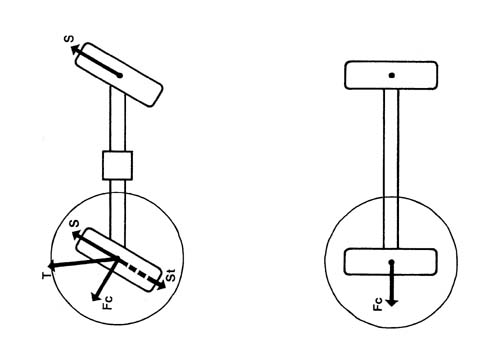
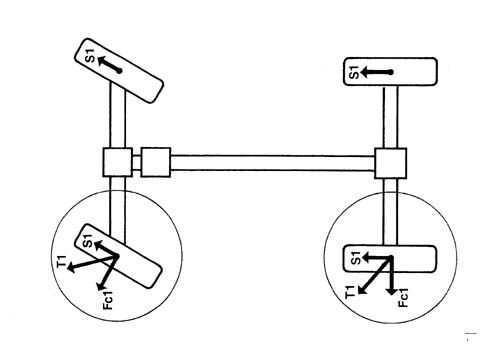
Permanent four wheel drive
- A vehicle with permanent four wheel drive has four drive wheels permanently engaged. Permanent four wheel drive is achieved by means of a force applied to the front differential crown wheel, an idler, a viscous coupling on the centre section of the propeller shaftt with the task of permanently modulating the front and rear wheel drive and a rear differential integrated in a rigid rear axle.Four wheel drive that can be switched on
- Four wheel drive that can be switched on allows the user to control the four wheel drive engagement directly, as and when needed (poor grip, steep hills) on vehicles that normally drive on two drive wheels. These vehicles are usually equipped with a drive from the gearbox or from the differential, a propeller shaft which normally freewheels, a rear differential and a drive engagement mechanism. This mechanism can be a clutch, a splined sleeve or a front toothed drive that can be switched on either manually or automatically.- The use of four wheel drive that can be engaged is advisable for poor grip conditions (snow, ice) or steep hills; compared with vehicles with two wheel drive it offers practical advantages in terms of performance and disengagement.General diagram showing 4x4 transmission with mlgu gearbox
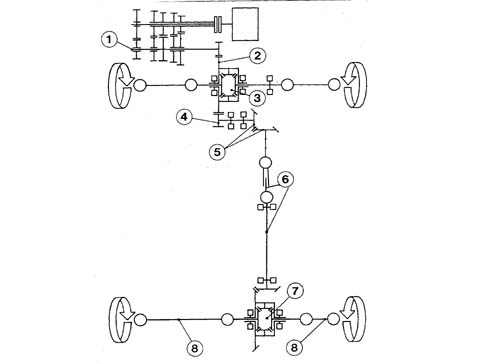
- The diagram below shows a 4x4 transmission.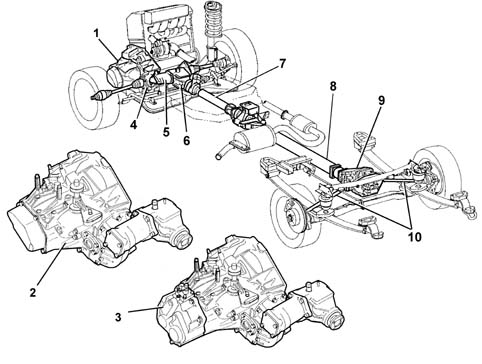
Drive transmission
- On the current Ducato 4x4 version the drive coming from the gearbox layshaft (1), with the ratios unchanged, passes through the front differential (3) ring gear (2) and reaches the front wheels.- At the same time, by means of the drive (4), the idler unit (5) and the longitudinal propeller shaft (6), the power arrives via the rear differential unit (7) and the driveshafts (8) at the rear wheels.